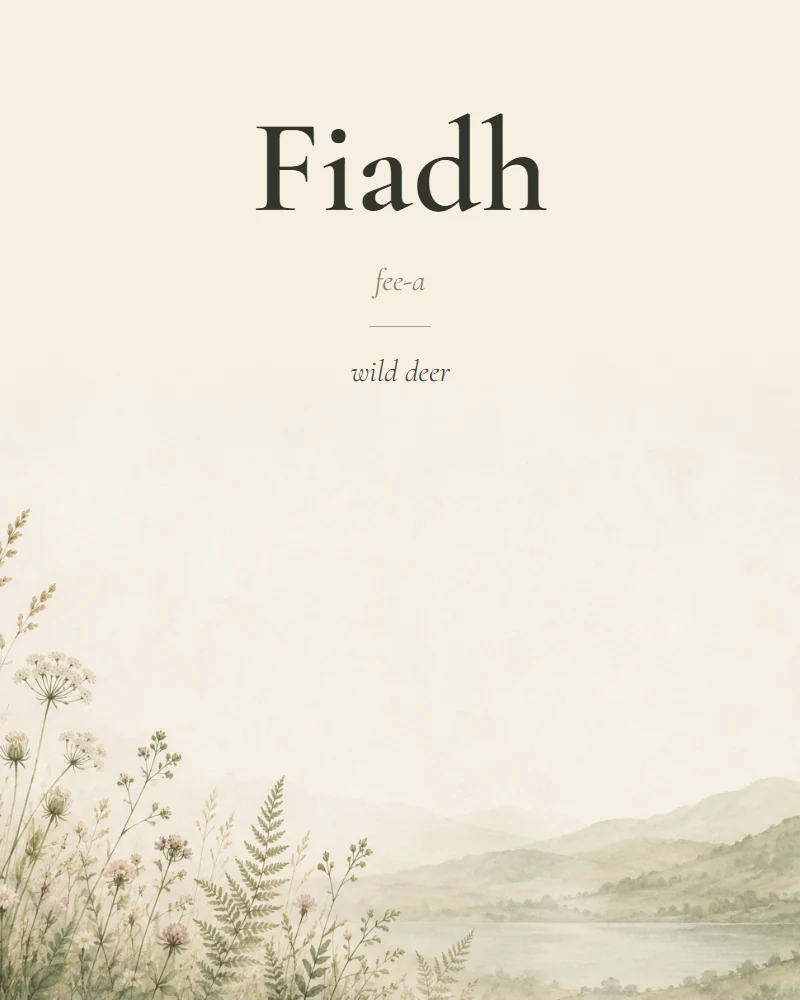
Fiadh
Means "wild deer" - the fastest-rising girls’ name in Ireland this decade.
all irish names, with pronunciations →Fiadh comes straight from fia, the Irish for deer, the wild kind that moves through woodland rather than the tame kind in a field. There is no saint behind it and no myth attached, just a single clean image: something quick, watchful and free. That plainness is part of the appeal. It does not need translating or explaining once you have heard it said.
What makes Fiadh remarkable is the speed of its rise. A generation ago it barely registered on the CSO's list of registered births; now it sits at or near the very top of the Irish girls' chart, overtaking names that had held the number one spot for years. It is a rare thing: a genuinely ancient Irish word that only became a first name in living memory, and one that Irish parents reached for in enormous numbers once they heard it.
six middles for fiadh
more middles for fiadh
Kept fully Irish
The pairings that keep her name Irish from end to end.
Fiadh Siobhán closes the short, open first name on a firm, two-syllable middle, 'wild deer, God is gracious,' and the shift from the light FEE-a to the grounded shih-VAWN gives the full name a clean, definite finish.
Fiadh Ciara sets 'wild deer' beside 'dark-haired,' two short, image-led names that both read as plain physical description, and the pair moves quickly without either name asking for more room than it needs.
Fiadh Eimear, 'wild deer, swift,' is almost a definition of itself, and the closed -mer ending gives Fiadh's breathless opening somewhere solid to land.
Fiadh Gráinne borrows some of the pirate queen's nerve for the newer name; 'wild deer' meeting 'grace' has a bit of bite to it, and Gráinne's rolling GRAWN-ya gives the short first name a proper second half.
Fiadh Aoibhín, 'wild deer, little beautiful one,' keeps both names gentle and unhurried, with Aoibhín's extra syllable letting the quick first name settle rather than stop dead.
Soft and lyrical
Still Irish, with a longer, singing cadence.
Fiadh Aisling pairs a creature of the woods with 'a dream or vision,' something seen rather than caught, and Aisling's two unhurried syllables give the clipped first name a slower, more thoughtful close.
Fiadh Éabha, 'wild deer, life,' sits two of Ireland's fastest-rising names side by side, and the shared open vowels let the pair flow into each other rather than colliding.
Fiadh Laoise, 'wild deer, radiance,' keeps the whole name light and quick, two short bursts of sound that end on Laoise's soft LEE-sha lift instead of a hard stop.
Fiadh Deirdre is a deliberate pairing of opposites: Fiadh's light, quick meaning set against Deirdre's old, sorrowful weight, and for parents drawn to that tension rather than away from it, the two-syllable Deirdre gives the short first name real ballast.
A classic middle, if you'd rather
Let the first name carry all the Irish and give the middle the easy job.
Fiadh Anne is about as plain as a middle gets, one flat syllable after the first name's open ending, and that very simplicity is the point, nothing left to pronounce or explain.
combinations to think twice about
Fiadh Fionnuala repeats the Fi- opening sound, and the two names run together instead of standing apart.
Another F-start. Fiadh Faye doubles the same soft sound twice in a row and the pairing loses its shape.
the music of fiadh
Fiadh is said FEE-a, one word, over almost before it starts. That short, open ending needs a middle willing to do a bit more work rhythmically, either a longer flowing name that gives the pair somewhere to go, or a firm one-syllable name that closes it down cleanly. Steer clear of anything starting with an F or Fi- sound (Fionnuala, for instance) as it echoes Fiadh's own opening and the two names blur into each other.